
Build - Elements of An Effective Software Organization
A guide to help good software teams get better and remain effective as the organization grows and evolves

The book Build Elements Of An Effective Software Organization by Rebecca Murphey and Otto Hilska serves as a guide to continuous improvement and focuses on three main areas: Business Outcomes, Developer Productivity and Developer Experience.
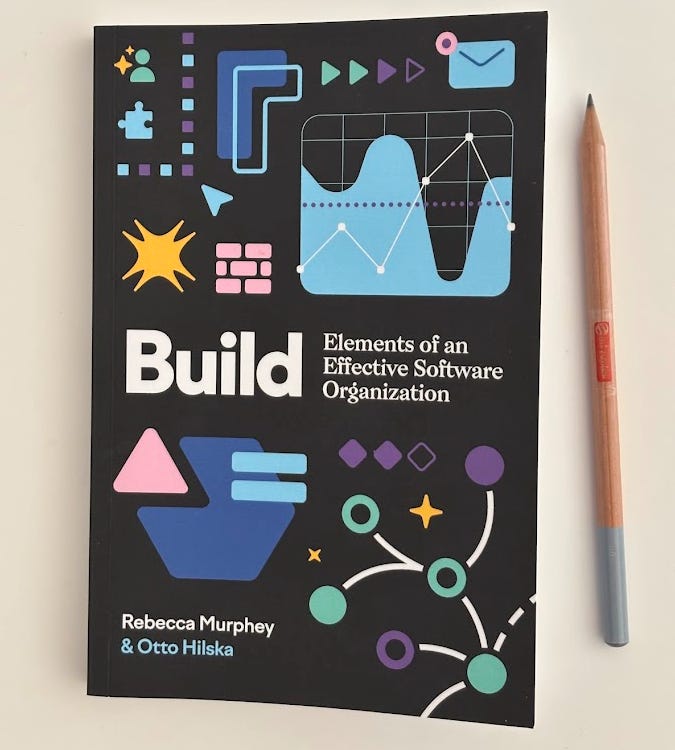
A short book that clearly and objectively introduces several well-established frameworks and references in the industry. I believe it’s useful for new leaders and managers, especially those working in companies at an early growth stage.
I’ll share a couple of ideas presented in the book, and I hope to inspire you to read this material as well.
The meeting dilemma
The underlying cost of a meeting isn’t limited to its duration; it extends to the interruption of deep focus.
A universal objective should be to secure uninterrupted blocks of concentration for all roles.
Here are some effective strategies to consider:
Clear objectives - Clarify it’s purpose, if the objective can be achieved through an email or a quick chat, opt for that instead.
Review recurring meetings - Periodically review meetings to determine if they’re still relevant or if their frequency can be reduced.
Time limits - Meetings that exceed 30 minutes should be rare, and meetings that exceed an hour should be exceptional.
Limit attendees - Invite only those who are essential to the meeting’s objective. A smaller, more relevant group can often make decisions more quickly.
Share the outcome of meetings - Small, focused, agenda-driven meetings don’t need to be secretive.
Asynchronous updates - For meetings that are informational or offer updates, consider asynchronous methods.
Balancing engineering investments
The Balance Framework is a model for understanding the distribution of an engineering organization’s efforts. It categorizes the organization’s work into four main areas:
New things - creating new features or services
Improving things - enhancing current features, services, and business processes.
Keeping the lights on (KTLO) - maintaining existing systems and services
Productivity work - making it easier to get work done
A healthy blend tends to include at least 10% for productivity work and between 10% and 30% for KTLO. You can read more about this framework here.
Investing in teams means more than just providing tasks; it involves nurturing their growth, capabilities, and cohesion.
These are just a few of the ideas presented in the book, and if they caught your attention as well, I believe it will be a worthwhile read.
See you soon!
Thanks for sharing, Lucas! You've made me want to read the book. The framework presented seems like a good inspiration.